

Technical Specifications and Material Composition
Release films consist of three fundamental components: the base substrate, the release coating, and optional backside treatments. The substrate provides mechanical strength and determines most physical properties. PET films (12-250µm thick) dominate the market due to their excellent dimensional stability, clarity, and temperature resistance. PP films (25-150µm) offer better chemical resistance and flexibility, while PE films (50-200µm) provide economical solutions for less demanding applications.
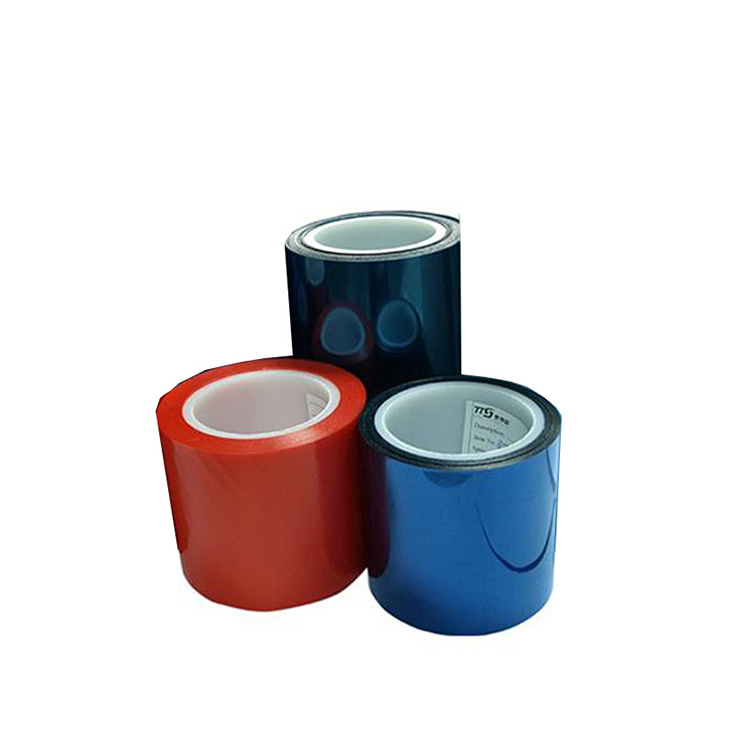
The release coating chemistry is equally critical. Silicone-based coatings remain industry standard, offering excellent release characteristics and thermal stability. These are typically applied at 0.5-2.0 g/m² coating weights. Newer non-silicone alternatives (fluoropolymer or urethane-based) address specific needs like low-migration for medical applications or compatibility with certain adhesives.
Advanced films incorporate multiple functional layers:
Primer layers for coating adhesion
Differential release sides (different peel forces on each surface)
Anti-static treatments (surface resistivity 10⁶-10¹¹ ohms/sq)
UV or EB-cured coatings for solvent-free production
Technical specifications include:
Tensile strength: 100-300 MPa (PET), 20-40 MPa (PP)
Elongation at break: 50-150%
Thermal shrinkage: <1.5% at 150°C/30 min
Haze: <5% for optical clarity applications
Quality control measures ensure consistent coating uniformity (<±5% variation), controlled release force (±10% tolerance), and absence of defects like pinholes or coating voids. Modern production lines utilize precision coating technologies including gravure, micro-gravure, and slot-die coating methods.
Pp Release film
Pp Release Film for Electronics Industry
Pp Release Film for Packaging Industry
Pp Release Film for Medical industry
Pp Release Film for Construction industry
Pp Release Film for Automotive Manufacturing Industry